Ultherapy Prime vs HIFU: the question isn’t which one is stronger

What you need to know
- Ultherapy Prime is one specific medical ultrasound platform; HIFU is a broad category containing many different devices.
- Both use focused ultrasound energy to create controlled thermal points beneath the skin and stimulate tissue remodelling.
- The major difference with Ultherapy Prime is real-time ultrasound visualisation, which lets the doctor see tissue layers during treatment.
- Neither treatment can reproduce a surgical facelift, and results depend heavily on how much laxity you actually have.
- A cheaper HIFU treatment is not automatically inferior, but comparing the devices only by “number of shots” can be misleading.
- Ultherapy Prime vs HIFU is a little like comparing one car model with an entire category
- The biggest difference with Ultherapy Prime is that the doctor can see where the energy is going
- Does that mean ordinary HIFU does not work?
- Ultherapy Prime has more evidence behind one standardised platform
- If your face is already significantly sagging, neither one may give you what you expect
- Is Ultherapy Prime really a one-session treatment?
- Which one hurts more?
- What about downtime and side effects?
- Why Ultherapy Prime usually costs more than HIFU in Malaysia
- So how do we decide between Ultherapy Prime and HIFU?
If you are comparing Ultherapy Prime vs HIFU, there is one important detail that most comparisons miss: you are not really comparing two equivalent machines. Ultherapy Prime is a specific microfocused ultrasound platform with integrated real-time imaging, while “HIFU” is a broad term covering many different focused-ultrasound devices. Both can be used for non-surgical skin tightening, but the device, treatment planning, energy delivery and your degree of skin laxity all affect what you can realistically expect.
Ultherapy Prime vs HIFU is a little like comparing one car model with an entire category
Patients often come into consultation saying:
“I’ve done HIFU before. Is Ultherapy Prime basically the same thing?”
The answer is both yes and no.
They belong to the same general family of ultrasound-based aesthetic treatments.
HIFU stands for high-intensity focused ultrasound. Ultherapy Prime uses a technology generally described in the medical literature as microfocused ultrasound with visualisation, or MFU-V.
Both approaches concentrate ultrasound energy at selected depths beneath the surface of the skin. This creates small, controlled thermal coagulation points that trigger tissue remodelling and new collagen formation over time.
So the basic principle is similar.
What is not necessarily similar is the machine delivering that energy.
There are numerous HIFU platforms in the market. Their transducers, energy consistency, treatment depths, software, protocols and clinical evidence can differ.
That is why somebody saying “I did HIFU” does not actually tell us very much.
We would want to know which machine was used, which areas were treated, what depths were selected and what the doctor was trying to correct.
The biggest difference with Ultherapy Prime is that the doctor can see where the energy is going
This is probably the most meaningful difference for patients to understand.
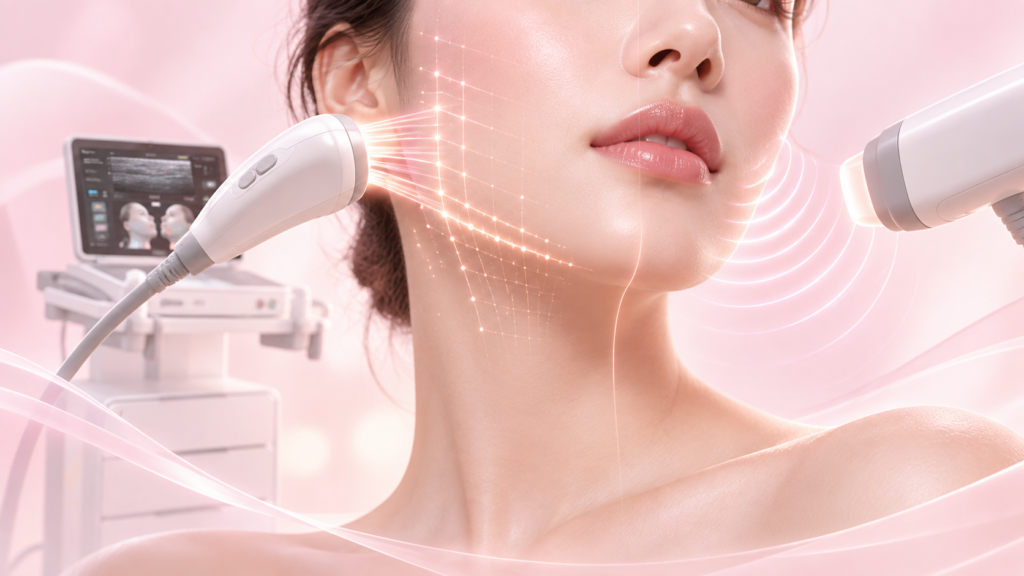
Ultherapy Prime includes real-time ultrasound imaging during treatment. The current platform displays tissue structures to a depth of up to 8 mm and provides a larger, clearer imaging field than the previous Ultherapy platform.
Why does that matter?
Human faces are not built to identical measurements.
One patient’s skin, fat layer and deeper tissue planes may sit differently from another patient’s. Even the two sides of the same face are not perfectly symmetrical.
With visualisation, the practitioner can assess the tissue beneath the handpiece rather than relying entirely on predetermined depth settings.
That does not mean a machine can automatically produce a good result.
The doctor still has to interpret what they are seeing and decide where treatment is appropriate.
But from our perspective, seeing the tissue adds useful information.
This is one reason we do not think comparing Ultherapy Prime vs HIFU purely by asking which machine has more “shots” is very meaningful.
Five hundred lines placed intelligently are not automatically equivalent to five hundred lines delivered using a different device or treatment plan.
Does that mean ordinary HIFU does not work?
No.
That would be an unfair conclusion.
There is published evidence supporting focused-ultrasound technology for facial tightening and rejuvenation. A 2025 systematic review examining HIFU treatments found evidence of improvement across aesthetic applications including skin tightening, although the devices and protocols studied varied considerably.
This is exactly the difficulty with discussing “HIFU” as if it were one treatment.
One HIFU machine is not necessarily equivalent to another.
Some devices have a meaningful clinical evidence base. Others have much less published data.
Some treatments are performed using carefully selected energy and depths. Others may be sold mainly according to an advertised number of lines.
So we would not tell a patient that every HIFU treatment is inferior to Ultherapy Prime.
We would tell them to find out what they are actually receiving.
The device matters.
The treatment plan matters.
And the person operating it matters.
Ultherapy Prime has more evidence behind one standardised platform
This is where Ultherapy has an advantage that is easier to evaluate.
Because Ultherapy is one defined system, studies performed using the platform contribute to a more consistent body of evidence than research grouped broadly under the HIFU label.
A 2025 systematic review and meta-analysis of microfocused ultrasound with visualisation included 42 studies. It found improvements in physician- and patient-assessed aesthetic outcomes, while also noting limitations in the available evidence and the need for further well-designed studies.
That last part is worth mentioning.
We do not think “clinically studied” should be translated into “guaranteed to work for everyone”.
It does not.
Results still vary according to age, anatomy, skin quality, severity of laxity and treatment technique.
The technology has evidence behind it. That is different from promising a specific result to an individual patient.
If your face is already significantly sagging, neither one may give you what you expect
This is the conversation we think clinics should have more often.
Ultherapy Prime is not a facelift.
HIFU is not a facelift either.
Ultrasound tightening makes the most sense when there is an appropriate amount of tissue laxity for a non-surgical treatment to address.
Someone beginning to notice softness around the jawline or mild-to-moderate laxity may be quite different from someone with substantial jowling, marked excess skin and significant structural ageing.
If the gap between what a patient has and what they want is too large, increasing the energy or doing more lines does not suddenly turn a non-invasive treatment into surgery.
In those cases, we would rather explain the limitation before treatment.
Sometimes another non-surgical treatment may contribute to the overall plan. For example, volume loss may require a completely different discussion involving Ellansé 少女针
But adding volume is also not a substitute for tightening loose skin.
This is why facial assessment matters more than choosing a machine from an advertisement.
Is Ultherapy Prime really a one-session treatment?
Ultherapy Prime is generally designed around a single treatment session followed by gradual collagen remodelling. Manufacturer information describes results developing after one session, with effects potentially lasting a year or longer in suitable patients.
Published studies of MFU-V also commonly assess results months after a single treatment rather than immediately afterwards.
That does not mean everybody needs exactly one treatment for the rest of their life.
Ageing continues.
Collagen continues to change.
Some patients may consider maintenance later depending on their response and goals.
With generic HIFU, it is much harder to give one universal answer because treatment schedules vary between devices and protocols.
We would be cautious about choosing between Ultherapy Prime and HIFU based solely on statements such as:
“This machine only needs one session.”
Or:
“This HIFU needs three sessions, so it must be weaker.”
Without knowing the device and treatment protocol, those comparisons are too simplistic.
Which one hurts more?
Neither treatment should be described as completely painless.
Focused ultrasound deposits energy beneath the skin, so patients can experience brief heat, prickling, aching or deeper discomfort as lines are delivered.
A 2025 meta-analysis of MFU-V studies found an average reported pain score of approximately 4.85 out of 10, although there was substantial variation between studies and patients.
Ultherapy Prime introduced a faster platform and workflow compared with the previous generation, but that does not mean every patient will find the procedure comfortable.
For HIFU, comfort varies even more because different machines, settings and treatment protocols are involved.
Pain is therefore not a reliable way to judge whether a treatment is “working”.
More painful does not automatically mean more effective.
What about downtime and side effects?
One attraction of both treatments is that they are non-invasive and usually require little interruption to normal daily activities.
Temporary redness, swelling, tenderness or sensitivity can occur.
More significant adverse effects appear to be uncommon in published MFU-V studies, but they have been reported. These include nerve-related symptoms, scarring and subcutaneous tissue changes in rare cases.
This is why we are careful with the phrase “no downtime”.
You may be able to return to normal activities quickly, but that does not mean nothing can happen after treatment.
And because focused ultrasound can reach deeper tissue planes, it should still be treated as a medical aesthetic procedure rather than an ordinary facial.
Why Ultherapy Prime usually costs more than HIFU in Malaysia
If you compare Ultherapy Prime vs HIFU in Malaysia, Ultherapy Prime will commonly sit at a higher price point.
That alone does not prove that it is the right treatment for you.
Part of what you are paying for is a specific branded platform, genuine treatment transducers, integrated ultrasound visualisation and a relatively large clinical evidence base.
Generic HIFU pricing varies widely because many different devices are being grouped under the same name.
We therefore recommend being cautious with simple calculations such as:
“Clinic A gives me 800 shots for less than Clinic B gives me 500.”
The number of lines does not tell you their depth, energy characteristics, placement, coupling quality or whether those lines are even necessary for your anatomy.
For medical aesthetic treatments, more is not always better.
So how do we decide between Ultherapy Prime and HIFU?
We start with the face, not the machine.
If a patient wants a non-invasive ultrasound treatment and values real-time tissue visualisation, a standardised platform and a substantial published evidence base, Ultherapy Prime may be worth discussing.
A reputable HIFU platform may also be reasonable for selected patients, particularly when the doctor understands the device well and the treatment plan matches the patient’s anatomy.
But there are also patients we would advise not to do either.
If there is very little laxity, there may be little to correct.
If laxity is advanced, the expected change may be too modest.
And if the problem you are seeing is actually volume loss rather than loose skin, ultrasound tightening may be addressing the wrong problem entirely.
That is ultimately the most important difference between a good consultation and a machine sale.
The question should not be:
“Which machine is stronger?”
It should be:
“What is causing my face to look this way, and which treatment — if any — actually makes sense for it?”
Have a question about this?
A consultation with an LS doctor is the honest next step — they'll tell you what suits you, and what doesn't.
WhatsApp a ConsultationFAQ
Is Ultherapy Prime the same as HIFU?
They are related but not identical. Both use focused ultrasound energy for non-surgical skin tightening. Ultherapy Prime is a specific microfocused-ultrasound-with-visualisation platform, while HIFU is a broad term that includes many different devices with varying technologies, protocols and evidence bases.
Is Ultherapy Prime better than HIFU?
There is no single answer because “HIFU” does not refer to one standard machine. Ultherapy Prime has integrated real-time ultrasound imaging and a large body of published evidence, while the capabilities of other HIFU devices vary. Suitability should depend on your anatomy, degree of laxity and treatment plan rather than the device name alone.
What is the difference between Ultherapy Prime and normal HIFU?
One of the main differences is real-time visualisation. Ultherapy Prime allows the practitioner to see tissue layers during treatment and select appropriate treatment depths. Many HIFU systems rely on predetermined treatment depths without the same integrated real-time imaging capability.
How many sessions of Ultherapy Prime do I need?
Ultherapy Prime is commonly performed as a single treatment followed by gradual collagen remodelling over the following months. Whether maintenance is appropriate later depends on your age, tissue laxity, response and ongoing ageing process.
How long do Ultherapy Prime results last?
Results develop gradually as collagen remodels and may last around a year or longer in some suitable patients. Duration varies between individuals, and no non-surgical ultrasound treatment permanently stops the ageing process.
Does Ultherapy Prime hurt more than HIFU?
Comfort varies considerably between patients and devices. Both focused-ultrasound treatments can cause heat, prickling or deeper aching during energy delivery. Pain level should not be used as a measure of treatment effectiveness.
The information here is meant to help you understand a treatment before you decide — it isn't a diagnosis or medical advice, and it can't replace seeing a doctor in person. Every face and every case is different, so results vary from person to person, and any treatment only goes ahead after an LS Clinic doctor has assessed that it's right for you.