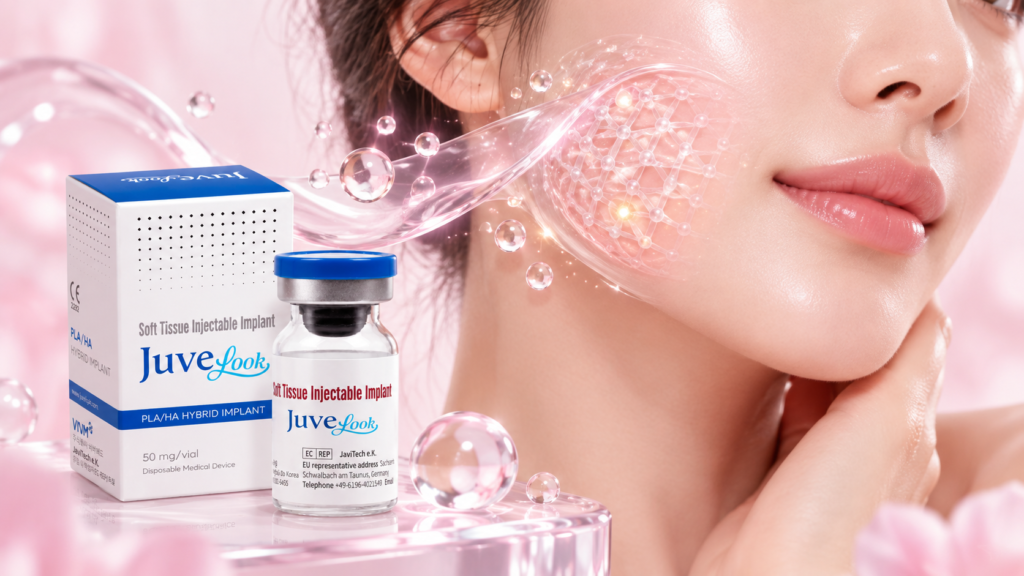
Juvelook Malaysia: not filler, and not just another skin booster

What you need to know
- Juvelook combines PDLLA, a collagen-stimulating material, with non-cross-linked hyaluronic acid.
- Its main role is improving skin quality gradually rather than creating obvious facial volume.
- Most treatment plans involve more than one session, so judging it after a single injection can be premature.
- It can be considered for concerns such as fine lines, texture, pores, certain acne scars and selected under-eye concerns, but it is not suitable for every problem.
- If you need significant lifting or structural volume replacement, Juvelook alone may not be the right treatment.
- Juvelook is difficult to understand because it sits between treatment categories
- If you want an immediate transformation, Juvelook may disappoint you
- So what does Juvelook actually make sense for?
- Juvelook under the eyes is interesting, but this is an area where judgement matters
- Juvelook vs filler: one is not an upgraded version of the other
- How many Juvelook sessions do you actually need?
- How much does Juvelook cost in Malaysia?
- Is Juvelook safe?
- Who would we tell not to do Juvelook?
- Is Juvelook worth it?
If you are researching Juvelook Malaysia, you have probably seen it described as a skin booster, collagen stimulator, injectable moisturiser and even an alternative to filler. Some of those descriptions contain part of the truth, but none explains the treatment very well. Juvelook combines PDLLA with hyaluronic acid and is designed more around gradual skin remodelling than obvious volume creation. Here is what that means in practice, how many sessions are commonly used, what it may cost in Malaysia and, importantly, when we would choose something else.
Juvelook is difficult to understand because it sits between treatment categories
Most injectable treatments are easier to explain.
Traditional hyaluronic acid filler primarily gives structure or volume.
A conventional skin booster focuses mainly on hydration and skin quality.
A collagen stimulator works by encouraging your own tissues to produce more collagen over time.
Juvelook sits somewhere in between.
Published descriptions of Juvelook identify it as a combination of poly-D,L-lactic acid, or PDLLA, with non-cross-linked hyaluronic acid. One studied formulation contained 42.5 mg of PDLLA and 7.5 mg of HA.
The HA component contributes to the immediate treatment environment and hydration, while the PDLLA particles are intended to stimulate a longer-term collagen response.
That is why simply calling Juvelook “a skin booster” can undersell what it is doing.
But calling it “a filler” can create the opposite problem: patients may start expecting it to build cheekbones, project a chin or immediately replace substantial lost facial volume.
That is not how we would usually think about it.
If you want an immediate transformation, Juvelook may disappoint you
This is one of the most important expectations to set before treatment.
Juvelook is not normally the type of injectable where we treat the face and expect the final result to be obvious when you leave the clinic.
Some early change can come from the treatment itself and the HA component, but the collagen-remodelling part takes time.
In a preliminary facial-rejuvenation study, patients underwent two or three PDLLA-HA treatments approximately four weeks apart.
A more recent prospective study of Juvelook for nasolabial folds also used three sessions at one-month intervals and evaluated patients after the treatment course.
That gives you a useful clue about how we should think about Juvelook:
It is generally a process, not an instant correction.
This is also why we are cautious when someone wants to try one session immediately before an important event and expects a major change.
There are treatments designed around quicker structural correction. Juvelook’s strengths are different.
So what does Juvelook actually make sense for?
The treatment becomes more logical when the concern is related to skin quality.
Depending on the patient’s skin and treatment technique, Juvelook may be considered for concerns such as:
fine lines,
early crepey texture,
reduced skin elasticity,
visible pores,
certain types of depressed acne scarring,
and selected under-eye concerns.
Clinical research is developing in several of these areas.
Studies have reported improvements in measurements of skin texture and rejuvenation after PDLLA-HA treatment, while newer publications have investigated Juvelook around the tear trough and for acne-scar treatment.
But we need to be careful with the word “treat”.
Acne scars, for example, are not all the same.
A rolling scar tethered down by fibrous bands may need subcision. An ice-pick scar may require a completely different approach. A shallow boxcar scar may respond differently again.
Injecting Juvelook into every person with acne scars because Juvelook is currently popular would not make sense.
Sometimes we may combine collagen stimulation with laser, subcision or a device treatment.
Sometimes Juvelook may not be the priority at all.
Juvelook under the eyes is interesting, but this is an area where judgement matters
The under-eye area is probably one reason Juvelook has attracted so much attention.
It is also one of the areas where we would be least comfortable treating based purely on social-media trends.
The skin here is thin. There are important blood vessels nearby. Fluid retention can be obvious, and not every “dark circle” is caused by the same problem.
A 2026 prospective study evaluated three Juvelook treatment sessions for tear-trough and under-eye rejuvenation in 15 women, reporting improvements in several assessed outcomes.
That is encouraging.
But 15 patients is still a small study.
We would not translate that into “Juvelook is suitable for every under-eye”.
Someone whose main problem is pigmentation may need a pigment-focused treatment.
Someone with significant eye bags caused by protruding fat may not get what they expect from an injectable skin treatment.
Someone with strong tear-trough hollowing may need a different structural approach.
The product matters, but diagnosis matters more.
Juvelook vs filler: one is not an upgraded version of the other
We sometimes hear:
“Why would I do normal filler if Juvelook can stimulate collagen too?”
Because they are solving different problems.
Suppose someone has significant temple hollowing or needs structural chin projection.
A suitable HA filler or another structural injectable may be far more predictable for that objective because we actually want volume and support.
Now take another patient with reasonably good facial structure but increasingly thin-looking, textured skin.
Adding conventional filler everywhere would make little sense.
That patient may be more suited to a skin-quality approach.
This is why we do not think of Juvelook as “better filler”.
And we do not think filler is “stronger Juvelook”.
They belong in different parts of an aesthetic treatment plan.
The same applies when comparing Juvelook with a collagen stimulator such as Ellanse.
Different formulations, particle characteristics, injection techniques and treatment goals mean they should not be treated as interchangeable syringes.
How many Juvelook sessions do you actually need?
There is no responsible answer that applies to everyone.
However, several published Juvelook studies have used treatment courses rather than one-off injections.
Protocols of two to three sessions roughly one month apart have been reported for facial skin rejuvenation, under-eye treatment and nasolabial-fold improvement.
Other delivery methods have used different schedules. One 2026 study examining Juvelook delivered through a needle-free microjet device used five treatment sessions.
That does not mean everyone needs five sessions.
It means the number depends partly on what is being treated and how the product is delivered.
For a patient, the more useful question is:
“How many sessions are you recommending for my specific concern, and when will we reassess whether it is working?”
We prefer that conversation to automatically selling a long package.
How much does Juvelook cost in Malaysia?
Current publicly advertised Juvelook Malaysia price information varies significantly.
Some Malaysian clinics currently publish approximate prices from around RM1,200 to RM2,500 per session, while another lists roughly RM1,800 to RM2,900 per session.
We would treat those only as broad market references, not a fixed Malaysian price.
The amount can vary because one quotation may involve a different treatment area, dilution protocol, amount of product, delivery method or number of sessions.
So before comparing prices, ask what is actually included.
A RM1,200 treatment and a RM2,500 treatment are not automatically the same treatment sold at two different margins.
And with injectable treatments, authenticity and practitioner qualification should matter more than finding the cheapest advertised number.
Is Juvelook safe?
Juvelook is injectable, so we would not describe it as risk-free.
Common temporary effects can include redness, swelling, tenderness and bruising at injection sites.
Published Juvelook studies have generally reported favourable short-term tolerability, but the evidence base is still relatively young and several studies involve small patient numbers.
Collagen-stimulating injectables can also carry risks such as persistent papules, nodules or inflammatory reactions depending on the material, placement and technique.
This is one reason preparation, dilution, injection plane and practitioner experience matter.
The internet sometimes presents collagen stimulation as though the body simply “makes more collagen” and nothing else needs consideration.
In reality, stimulating tissue is a biological process. We want it happening in the right place and in a controlled way.
Who would we tell not to do Juvelook?
Sometimes the problem is not whether Juvelook can be injected.
It is whether Juvelook can deliver what the patient wants.
If someone comes in with substantial facial sagging and wants a dramatic lift, we would not position Juvelook as a substitute for a lifting procedure such as Ultherapy Prime.
If significant facial volume has been lost, we may need to discuss structural replacement rather than a skin booster.
If deep acne scars are tethered down, simply stimulating collagen above them may not solve the mechanical problem.
And if somebody’s skin is already good and they are doing treatment mainly because everyone online is doing it, we are comfortable saying they may not need it yet.
That is not a missed treatment opportunity.
It is part of practising aesthetic medicine properly.
Is Juvelook worth it?
Juvelook becomes interesting when your goal is subtle, progressive improvement rather than obvious reshaping.
For selected patients, the combination of HA and PDLLA gives us another way to work on skin quality while encouraging collagen remodelling.
The early clinical evidence is promising.
But compared with some older aesthetic technologies, Juvelook still has a relatively developing evidence base, with several available studies involving small groups or specific treatment techniques. That is worth being transparent about.
We would therefore choose Juvelook because it matches a patient’s concern, not because it is currently trending.
If your goal is better texture, fine lines, certain acne scars or selected under-eye concerns, it may be worth discussing.
If the issue is primarily pigmentation, substantial laxity or structural volume loss, there may be a better tool for the job.
The consultation should answer that question before the syringe is opened.
Have a question about this?
A consultation with an LS doctor is the honest next step — they'll tell you what suits you, and what doesn't.
WhatsApp a ConsultationFAQ
What is Juvelook?
Juvelook is an injectable treatment combining poly-D,L-lactic acid (PDLLA), a collagen-stimulating material, with non-cross-linked hyaluronic acid. It is generally used to improve skin quality gradually rather than to create the obvious structural volume associated with conventional dermal fillers.
How many Juvelook sessions are needed?
Treatment plans vary, but several published Juvelook studies have used two to three sessions spaced about four weeks apart. The appropriate number depends on the treatment area, skin condition, delivery technique and individual response, so patients should be reassessed rather than assuming everyone needs the same package.
How much does Juvelook cost in Malaysia?
Current publicly advertised Juvelook prices in Malaysia commonly vary from roughly RM1,200 to RM2,900 per session, although this is only a broad reference. Cost depends on the amount used, treatment area, technique, practitioner and number of sessions required.
Is Juvelook a filler or skin booster?
Juvelook sits between the usual categories. It contains hyaluronic acid but also PDLLA, which stimulates collagen production over time. It is commonly used for skin-quality improvement rather than the stronger structural shaping and volume replacement expected from conventional dermal fillers.
Can Juvelook be used for acne scars?
Juvelook may be considered as part of a treatment plan for certain atrophic acne scars because collagen stimulation can support dermal remodelling. However, scars that are deeply tethered, narrow or structurally complex may require other treatments such as subcision, laser or combination therapy.
How long does Juvelook take to show results?
Some early improvement may be noticed after treatment, but the collagen-stimulating effect develops gradually over the following weeks and months. Juvelook should therefore not be judged like an instant-volume filler, and multiple treatment sessions may be recommended before the final response is assessed.
The information here is meant to help you understand a treatment before you decide — it isn't a diagnosis or medical advice, and it can't replace seeing a doctor in person. Every face and every case is different, so results vary from person to person, and any treatment only goes ahead after an LS Clinic doctor has assessed that it's right for you.