Sculptra Malaysia: if you want an instant filler result, this may be the wrong treatment

What you need to know
- Sculptra is a PLLA collagen stimulator, not a conventional hyaluronic acid filler.
- The early fullness after treatment is not the final result — meaningful changes develop gradually as collagen is stimulated.
- Most patients should think in terms of a treatment course rather than expecting everything from one vial or one session.
- Sculptra makes more sense for broader collagen and volume loss than for someone wanting an immediate, highly precise change to one feature.
- Results can last up to around two years in studied patients, but individual response and treatment needs vary.
- If your face looks fuller immediately after Sculptra, don’t judge the result yet
- The question with Sculptra is not “where should we fill?” but “where has the face lost support?”
- Sculptra is a collagen stimulator — but that does not mean it can tighten everything
- Who tends to understand Sculptra best?
- Why one Sculptra session may not tell you very much
- Sculptra vs filler: which one would we choose?
- How long does Sculptra last?
- How much does Sculptra cost in Malaysia?
- The downside of Sculptra is that technique matters and you cannot simply dissolve it
- Who would we tell not to do Sculptra?
- Is Sculptra worth it?
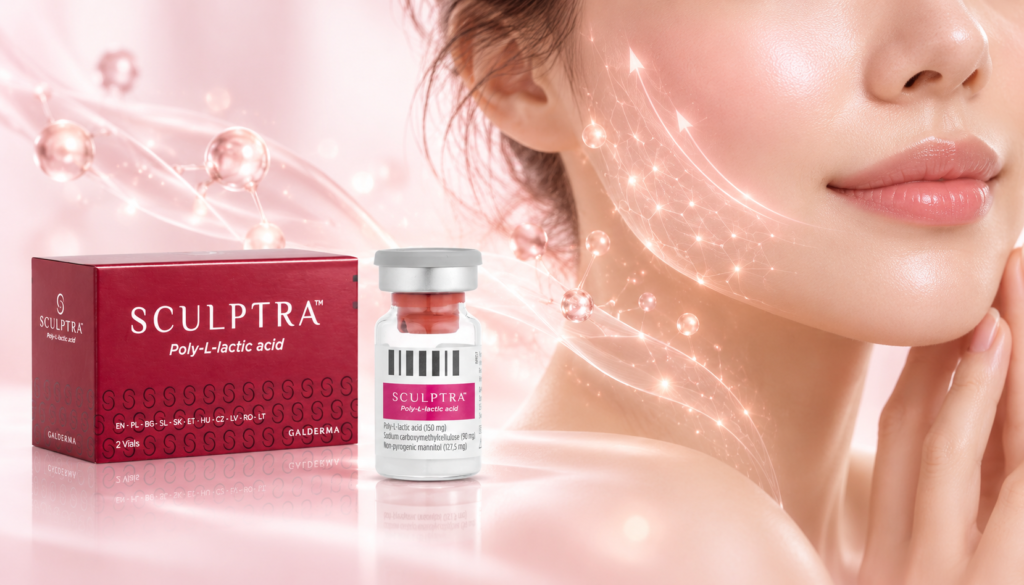
If you are researching Sculptra Malaysia, there is one thing worth knowing before comparing prices or counting vials: Sculptra is not designed to behave like an ordinary filler. It uses poly-L-lactic acid (PLLA) to stimulate your own collagen gradually, so the result develops over weeks and months rather than being fully visible on injection day. That makes Sculptra particularly interesting for broader facial ageing and collagen loss — but also a poor choice for someone expecting an instant, highly precise transformation.
If your face looks fuller immediately after Sculptra, don’t judge the result yet
This is probably the strangest thing about Sculptra for first-time patients.
You may look in the mirror immediately after treatment and think:
“This is exactly what I wanted.”
Then some of that fullness disappears.
That does not necessarily mean the treatment has stopped working.
Sculptra is supplied as PLLA particles that are reconstituted before injection. The fluid used during treatment creates some initial fullness, but much of that early volume settles relatively quickly.
The more important process happens afterwards.
PLLA particles interact with the surrounding tissues and stimulate fibroblast activity and new collagen formation. The facial change therefore develops progressively rather than behaving like a fixed volume of gel sitting underneath the skin.
Official Sculptra information states that many clinical-study participants began seeing changes from around one month, with improvement developing over time.
So if someone wants to look significantly different tomorrow, we would usually explain that Sculptra is probably not the most logical injectable.
Its appeal is exactly the opposite.
It is supposed to be gradual.
The question with Sculptra is not “where should we fill?” but “where has the face lost support?”
This is where Sculptra differs most from the way many patients think about filler.
With a conventional HA filler, we can use products with different properties to make relatively specific structural changes.
Need more chin projection?
Need support in a particular part of the cheek?
Need to correct one selected depression?
Those are situations where dermal filler may make sense.
Sculptra is often more interesting when the problem is broader.
Perhaps the cheeks gradually look flatter.
The temples look more hollow.
The lower face is starting to look less supported.
The skin does not have the same firmness it had several years ago.
Nothing looks dramatically “wrong”, but the whole face appears slightly more tired or deflated.
That pattern is often related to several ageing processes happening at once, including changes in collagen and soft-tissue volume.
Sculptra allows us to think about the face as a whole rather than simply filling one wrinkle at a time.
Sculptra is a collagen stimulator — but that does not mean it can tighten everything
“Stimulates collagen” has become one of the most overused phrases in aesthetic medicine.
Almost every treatment now seems to claim it.
So it is worth being more precise.
Sculptra contains poly-L-lactic acid, a biodegradable material with a long history of medical use. After injection, its particles create a biological response that encourages collagen deposition within the treated tissues. Reviews of PLLA research have found improvements in facial volume, dermal thickness and other aesthetic measures, although the quality of the available evidence is not equally strong across all studies.
But collagen stimulation does not turn Sculptra into a facelift.
If significant loose skin is hanging around the jawline, simply producing more collagen may not create the amount of lifting a patient expects.
In that situation, a device treatment such as Ultherapy Prime or HIFU may be part of a more appropriate discussion.
Likewise, Sculptra does not replace every filler treatment.
A collagen stimulator and a structural HA filler can have very different jobs.
Who tends to understand Sculptra best?
In our experience, Sculptra usually makes the most sense to someone who says:
“I don’t want to suddenly look filled. I just feel like I’ve lost something over the last few years.”
That is a very different request from:
“I want my chin to be noticeably sharper today.”
The first patient may appreciate Sculptra’s gradual nature.
The second may find it frustrating.
Sculptra can be considered when broader age-related volume and collagen loss are becoming noticeable and the patient prefers a progressive change rather than an obvious immediate correction.
It can also be attractive to people who do not want to keep chasing every new line individually.
Instead of treating a nasolabial fold, then another fold, then another depression as separate problems, we can assess how much of the change is coming from declining facial support.
But age alone does not decide suitability.
A 30-year-old can have genuine facial volume loss.
A 50-year-old may still have excellent volume and need something completely different.
We treat the anatomy rather than the birthday.
Why one Sculptra session may not tell you very much
Sculptra is usually better understood as a treatment course.
Official product information describes an average of two to three treatment sessions over several months. A common studied approach is three sessions separated by at least three to four weeks, although the actual number should be individualised.
Clinical literature has similarly supported allowing adequate time between sessions because the response develops gradually and treating too quickly can increase the risk of overcorrection.
This is why we would not automatically look at a patient’s face two weeks later and say:
“Not enough. Add another vial.”
The collagen response is still developing.
With Sculptra, patience is part of the treatment.
At the same time, we do not believe every patient should automatically be sold the same three-session package.
Some require more correction than others.
Some respond differently.
Some may reach an appropriate endpoint sooner.
The plan should be reviewed as the face changes.
Sculptra vs filler: which one would we choose?
Neither is universally better.
They solve different problems.
HA filler gives us relatively immediate, controlled volume and can usually be dissolved with hyaluronidase if medically appropriate.
Sculptra gives us a gradual collagen-stimulating response across the treated tissue.
If you want precise lip augmentation, for example, Sculptra is not the treatment we would reach for.
If someone has one clearly defined area that needs structural projection, filler may be more predictable.
But if the concern is broader age-related deflation across the cheeks, temples or facial contours, Sculptra may become much more interesting.
This is also why we do not describe Sculptra as simply “a filler that lasts longer”.
Its treatment behaviour is fundamentally different.
How long does Sculptra last?
Current manufacturer data reports results lasting up to two years in studied patients after an appropriate treatment course.
Clinical literature on injectable PLLA has also reported sustained effects around 18 to 25 months in many patients.
But we would be careful about converting that into a promise.
Some patients will notice changes for longer.
Others may consider maintenance earlier.
Your starting degree of volume loss, age, treatment amount, metabolism and ongoing ageing all influence what happens afterwards.
Sculptra stimulates collagen.
It does not stop the biological ageing process.
How much does Sculptra cost in Malaysia?
If you are comparing Sculptra Malaysia price, it is more useful to look at cost per vial and the expected full treatment course.
Current publicly advertised prices from Malaysian clinics commonly sit around RM2,500 to RM3,000 per vial, although actual quotations vary according to clinic, treatment area, doctor’s assessment and number of vials required.
Some clinics also price a multi-session course differently, so the headline price for one vial may not represent the eventual total treatment cost.
We think patients should ask two questions before comparing quotations:
“How many vials are you recommending for me?”
And:
“What is the expected total treatment course?”
Otherwise, RM2,600 versus RM2,900 does not tell you very much.
One doctor may be proposing one vial.
Another may be discussing a broader plan over several sessions.
The downside of Sculptra is that technique matters and you cannot simply dissolve it
Sculptra has an important trade-off.
Unlike HA filler, PLLA cannot simply be dissolved with hyaluronidase if you change your mind.
That makes product preparation, treatment depth, distribution and patient selection particularly important.
Temporary swelling, tenderness, redness and bruising can occur after treatment.
Papules or nodules are also recognised complications of PLLA injections. A 2024 systematic review found bruising, tenderness, oedema, haematoma and nodules among reported adverse effects, while also noting that the overall quality of evidence still has limitations.
Good technique has evolved substantially over the years, including changes in reconstitution and injection methods intended to reduce these problems.
Aftercare matters too. Depending on the treatment protocol, patients may be instructed to massage the area after treatment; official Sculptra guidance describes the commonly known “5-5-5” approach — five minutes of massage, five times daily, for five days. Your treating doctor should give you the specific instructions appropriate for your treatment.
Who would we tell not to do Sculptra?
We would hesitate if somebody wants a major visible change immediately.
We would also reconsider Sculptra when the concern is so localised that a more precise injectable makes better sense.
If the patient expects Sculptra to dramatically lift advanced sagging, we would correct that expectation.
And if someone already has good facial support and is mainly interested because Sculptra is currently popular, doing nothing may genuinely be an option.
The same applies when a patient keeps asking:
“How many vials can I put?”
That is not how we think about it.
The objective is not to stimulate as much collagen as physically possible.
The objective is to restore an appropriate amount of support without making the face look heavier.
Is Sculptra worth it?
For the right type of patient, this is exactly why Sculptra has remained relevant for so many years.
It does something different from an ordinary filler.
Instead of creating all of its effect through injected gel volume, it asks the body to gradually rebuild collagen around the treated areas.
That makes the change slower.
It usually requires more patience.
And it often involves a course rather than one appointment.
But for patients who value a gradual result and want to address broader collagen and volume loss rather than dramatically reshape one feature, that can be the reason to choose it.
At LS Clinic, we would rather decide whether Sculptra fits the face first than decide how many vials to sell.
Because with collagen stimulators, the best result is often the one that develops so gradually that other people notice you look better — without being able to identify exactly what changed.
Have a question about this?
A consultation with an LS doctor is the honest next step — they'll tell you what suits you, and what doesn't.
WhatsApp a ConsultationFAQ
What is Sculptra?
Sculptra is an injectable collagen stimulator made from poly-L-lactic acid, or PLLA. Rather than acting mainly as an immediate gel filler, it stimulates a biological response that encourages new collagen formation gradually over the weeks and months following treatment.
How many Sculptra sessions do I need?
Most patients should think in terms of a treatment course rather than one session. Official Sculptra information describes an average of two to three treatment sessions over several months, but the appropriate number of sessions and vials depends on your degree of volume and collagen loss and should be individualised.
How much does Sculptra cost in Malaysia?
Current publicly advertised Sculptra prices in Malaysia commonly range around RM2,500 to RM3,000 per vial. The full treatment cost depends on how many vials and sessions your doctor recommends, so comparing the total treatment plan is more useful than comparing one advertised vial price.
How long does Sculptra last?
Sculptra results have been shown to last up to around two years in clinical studies after an appropriate treatment course. Individual duration varies, and maintenance may eventually be considered because Sculptra does not stop the normal ageing process.
Is Sculptra better than filler?
They are designed for different purposes. HA filler is useful when immediate and precise structural volume is wanted and has the additional advantage of being dissolvable. Sculptra is often more suitable when the goal is gradual collagen stimulation and broader restoration of age-related facial support.
When will I see results from Sculptra?
Some patients begin noticing improvement from around one month, but Sculptra develops gradually as collagen formation occurs. The result should therefore be assessed over several months and across the recommended treatment course rather than immediately after the first injection.
The information here is meant to help you understand a treatment before you decide — it isn't a diagnosis or medical advice, and it can't replace seeing a doctor in person. Every face and every case is different, so results vary from person to person, and any treatment only goes ahead after an LS Clinic doctor has assessed that it's right for you.